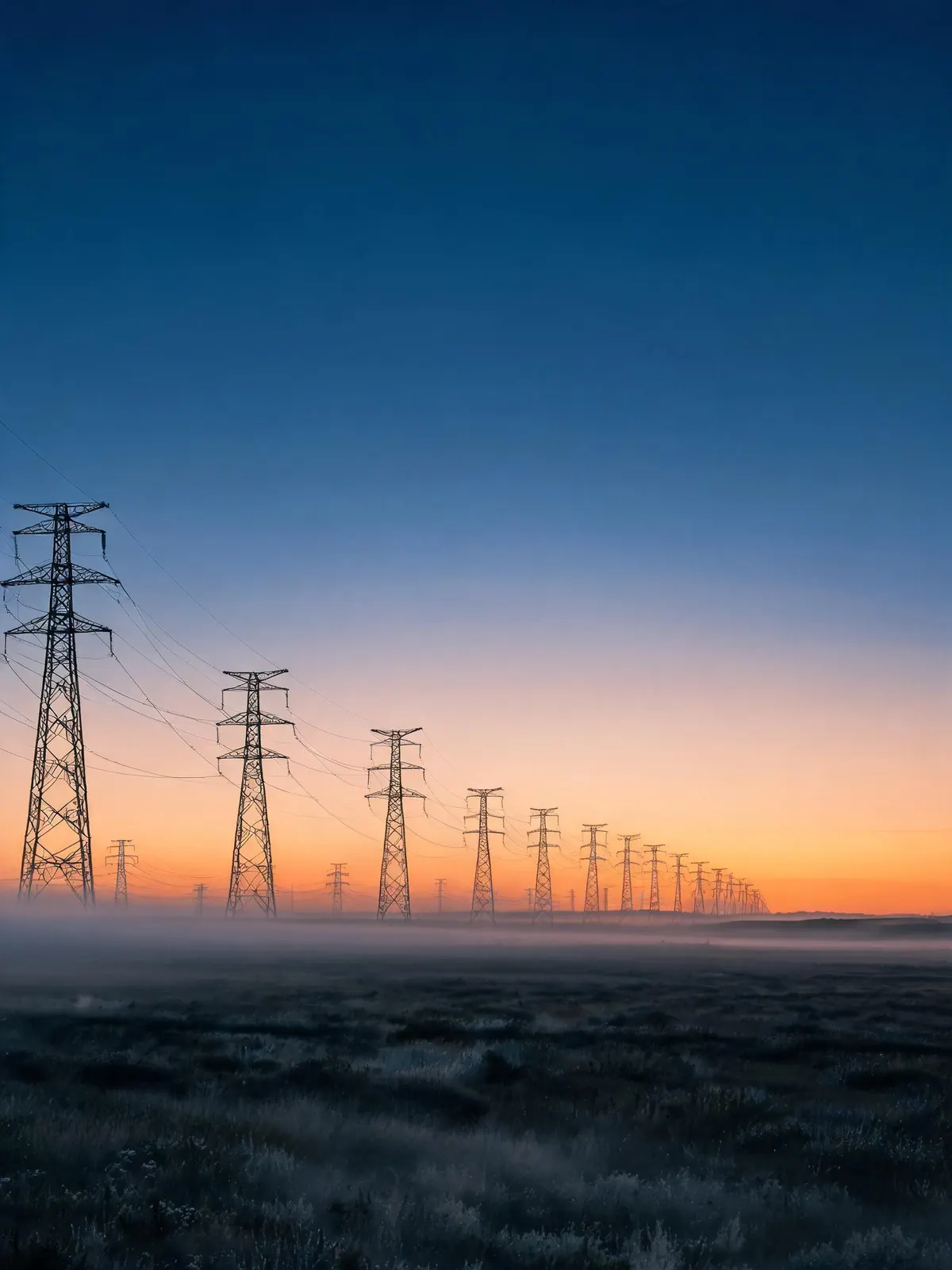
Capital, annual
$300B+
Yearly capital now flowing into new data center campuses worldwide, by current industry estimates.
Field Despatch · 2026 Edition
Every new AI campus breaks ground as a construction job before it ever ships a product. Concrete, copper, transformers, cooling water. We keep a free ledger on who sells that gear, and we read it so you can too.
 Send Me the Free Field Handbook
Free on WhatsApp · No forms, no fees, no spam
Send Me the Free Field Handbook
Free on WhatsApp · No forms, no fees, no spam
Written for investors who remember 1999·and 2008
Forget the keynote videos. Look at what is being ordered, poured and strung. Three numbers tell you more about the AI trade than a hundred podcasts.
Capital, annual
$300B+
Yearly capital now flowing into new data center campuses worldwide, by current industry estimates.
Electricity, projected
3×
How many times AI’s share of global electricity demand is projected to climb by 2030, per public energy outlooks.
Grid gear, lead time
3–4YRS
Typical wait, from order to delivery, for large transformers and other heavy grid equipment.
Directional figures, rounded. Sources and vintage dates are printed inside the handbook.
Strip the hype off an AI data center and three businesses remain, stacked on one concrete pad. Each carries a different kind of risk.
Line 01 · The model makers
Brilliant, crowded, and one release away from yesterday’s news. When the argument is about whose app wins, these are the folks in the argument.
Line 02 · The campus landlords
Heavy capital, long contracts, real bills sent to real tenants every month. Less glamour, more invoice.
Line 03 · The grid suppliers
They wind the transformers, string the wire and pour the substations. The work gets done whether or not any model ever turns a profit.
Three different bets. Only one of them doesn’t need to pick a winner.
Before a single server hums, a campus has to clear three gates. The handbook shows you where each gate sits and what to read when you get there.
No grid connection, no campus. It’s a drawing in a pitch deck. Regional operators run waiting lists measured in years, and a place in line beats a press release any day of the week.
What we read
A rack of top-shelf chips is a space heater with a stock ticker attached. Every watt that goes in comes back out as heat, and physics doesn’t take meetings.
What we read
Advanced silicon is sold out years ahead, and a new fab takes years to build even after the shovel hits the dirt. Out here, the waiting list is the moat.
What we read
Four chapters, plain English, zero jargon walls. It reads like a good site memo, because that is what it is.
Who is ordering power, how much of it, and on whose schedule.
Towers, transformers, switchgear, cooling loops: who actually builds each piece of the kit.
Order books, backlogs and delivery gaps, read the way a utility accountant reads them.
Sizing, exits and diversification, written like site safety rules you don’t cross.
Get the Handbook Free
Read it, keep it, leave the group whenever
If you were buying stocks in 1999, you already know what a burn rate sounds like when it calls itself a business plan. If you held anything in 2008, you know what the word “safe” turned out to mean. So when a twenty-something with a podcast tells you this time is different, you don’t argue. You ask to see the wiring.
This desk doesn’t write for the FOMO crowd. We write for Americans who’ve paid tuition in at least one bubble and would like the boring side of the trade for once: the contractors, not the dreamers.
“The railroads carried fewer dreamers than expected. The rails got paid either way.”
Field Note Nº 17 · The Megawatt Ledger
No. We’re educators, not brokers, and we don’t publish tickers or trade signals. The handbook explains how the machinery fits together. What you do with that understanding is your decision.
Zero. No card on file, no trial that expires, no premium tier hiding behind the free one. It’s a field handbook, not a funnel.
Because that’s where our readers already are. One tap, the handbook lands in your chat, and the group is easy to leave when you’re done with us.
American investors, mostly 35 and older, who’d rather understand the plumbing of the boom than argue about it at a barbecue.
Public records: interconnection queue filings, energy agency outlooks, and the order books suppliers publish. Each figure carries its source and its date, so you can see how fresh it is.
Tonight, somewhere in America, a substation gets its upgrade and a transformer order gets signed. The field handbook tells that story in plain English, and it costs nothing to read.
Send Me the Free Field Handbook
Free on WhatsApp · No forms · Leave any timeEducation·not advice
We publish education, not advice. Any investment can lose money, and some can lose it all. Talk to a licensed financial adviser before you commit a dime.